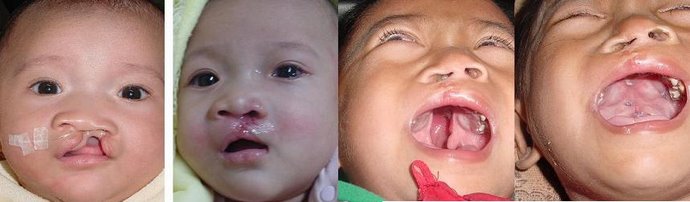
 Cleft lip and palate are the most common congenital anomalies in Indonesia. Nearly one to 600-700 babies born with these anomalies. In Indonesia every year born 5500-6500 new babies with cleft. The treatment we do usually only primary closure for lip and palate.
We do this procedure in the centre of OMFS and charity or public service program in Indonesia, these cases usualy affect the lower level people.
In the centre we start the treatment on 7 days old babies with feeding plate, 3 months old for lip repair, 18-24 months old for palate repair, 11-13 years old for ABGA (Alveolar Bone GraftAugmentation) and 18 years old for Orthognatic Surgery (if necessary). In the charity program we just do the primary closure for lip and palate and the patient usualy come in various ages.
We start this procedure usually 10-12 weeks old babies. We use Tenisson triangular flap technique for Unilateral Cleft closure with modification of Dr. Noordhof technique for nasal reconstruction, this procedure is easy to learn, the point marker are obvious and can be utilized on the several of wide cleft.
Some of the patients are teenager, sometimes we do the surgery under local anesthesia for cooperative patients. For bilateral cleft closure we use Veau III straight-line closure and we do both side on one procedure. We also do management of the muscle to repair the muscle.
For the over protrusive premaxilla, we do reposition by fracturing the premaxilla bone in front of the sutura, reduce the protusive and fix it with small wire on the same procedure with lip repair.
The palate repair start on 18-24 months old. The repair for hard palate and soft palate are done in one procedure. We used push back technique and combine with Z-plasty for lengthening the soft palate.
Showing posts with label Oral and Maxillofacial. Show all posts
Showing posts with label Oral and Maxillofacial. Show all posts
Friday, May 11, 2007
| [+/-] |
Primary Cleft Closure in Indonesia |
Saturday, May 5, 2007
| [+/-] |
Osteodistraction |
 The placement of dental implants needs an adequate alveolar ridge in width and height, therefore restoration of deficiencies of alveolar bone is necessary. Different types of augmentation bone procedures has been described.
The procedures can be classified between those with autogenous and those with alloplastic materials i.e. hydroxylapatite.The sucessfull osseointegration of dental implants is only possible in vital bone material. Beside the amount of bone also the vitality of the bone very important for the successfull incorporation of implants.This is the reason why implants osseointegration in radiated bone is not so easy to achieve. The autogenous bone augmentation procedures can be calssified basically in free bone transplants and in those with microsurgically bone pocedures. Commonly the free bone grafts are successful for implants augmenation procedures.
Depending on the amount of graft is needed the donor site is choosen. In many patients the bone delivered from iliac crest. Mostly the implants are inserted in a second procedure after healing of the bone transplants. This is almost completed after 4 months of bone transplantation. The most important argument against the bone transpaltantion procedure is the donor site morbidity. The procedure takes longer time; the patient has to stay in the hospital and defects in the donor site are possible. Besides the morbidity for the patient the costs of this procedure are quite high. So another procedures for alveolar ridge augmenation were looked for.
A technique using osteotomy with different type of mobilization is the procedure of ostedistraction. This technique was the first described by Iliazarov for lenthening of the lower limb. McCarthy used this technique for lengthening of the mandible in children with hemifacial microsomia. Block et al (1996), described the augmentation of the deficient alveolar ridge with osseodistraction for implant insertion at the animals.
The advantages of this technique are mobilization of a vascularized bone segment and no need for second procedure harvesting bone transplantations, therefore the morbidity can be reduced. Besides this the recontruction of soft tissue is also possible with the lengthening of the bone. Vertical lengthening of the alveolar process is quite easy possible. But the broadening of the alveolar process is not so easy possible and the distractor advices are not so cheap, those are the disanvantage of this procedure.


Subscribe to:
Posts (Atom)